Research
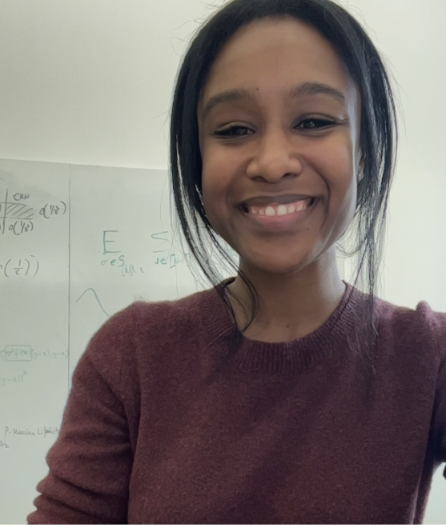
Dr. Ashia Wilson runs the Optimization, Safety, and Evaluation (OSE) Lab. The lab develops foundations for machine learning systems that are efficient, safe, and meaningfully evaluated. Our work spans optimization and sampling methods for efficient and reliable learning at scale; AI safety, with a focus on image-based abuse, child safety, and epistemic harms such as homogenization and sycophancy; and evaluation methods that support valid, decision-relevant conclusions about AI systems and their societal impacts.
Optimization
Mathematical principles for making computation more efficient, and for preserving utility when learning must satisfy human-centered requirements.
Publications →Safety
Detecting and controlling harmful model behavior, and understanding how AI systems shape agency, knowledge, and opportunity.
Publications →Evaluation
Turning latent constructs into valid measurements, and aligning evaluation with the decisions and consequences that matter.
Publications →Recent News
New preprint: Operationalizing NCII and CSAM Law in the Age of AI charts a research agenda at the intersection of AI safety and law, identifying the technical foundations needed to make legal protections against image-based abuse effective.
Our work on Evaluation without Generation received a Spotlight at the NeurIPS 2026 AI4GOOD Workshop and was featured in Bloomberg News and MIT News. It introduces a method for detecting harmful specialization in generative AI models without producing harmful content, enabling safer, scalable auditing for potential misuse, including the generation of CSAM.
Our work on private linear regression received an ICML 2026 Spotlight.
Co-organizing a NeurIPS 2026 workshop on child safety in AI.
Co-organized an ICML 2026 tutorial on machine unlearning.
Our work on sycophancy received a CHI 2026 Honorable Mention and was featured in MIT News.
I was named 2026 Junior Bose Award winner.